 EN
EN
What are you looking for?
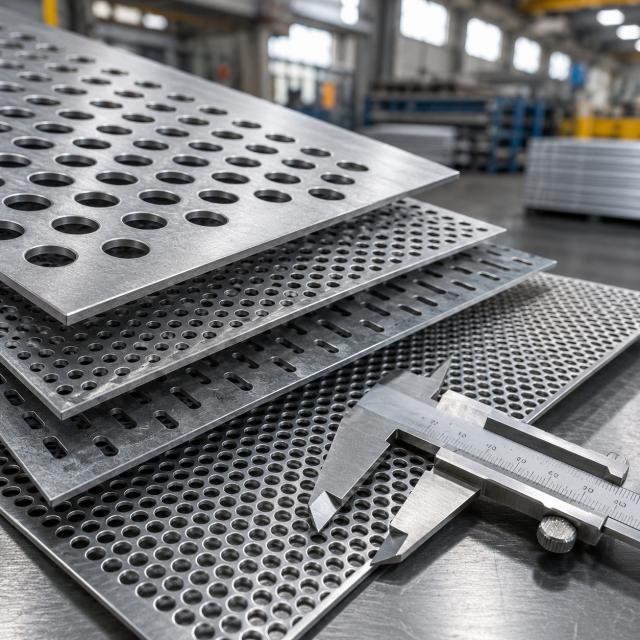
A workable perforated sheet specification should define four parameters together: hole size, pitch, sheet thickness, and open area. Changing any one of them can affect airflow, filtration accuracy, weight, rigidity, appearance, and manufacturing feasibility.
For most purchasing projects, the specification should therefore start with the required function rather than selecting a hole pattern from a catalogue. A ventilation panel may prioritize open area, while a machine guard may need more remaining metal and greater stiffness. Filtration, acoustic, and architectural applications create different balances again.
Pitch is the center-to-center distance between adjacent holes.
It should not be confused with the clear distance of metal remaining between two holes, often called the ligament or bar width. For example, if round holes are 5 mm in diameter and the pitch is 8 mm, the metal remaining between neighboring holes is approximately 3 mm along that measurement direction.
This distinction matters when sending drawings or RFQs. Writing only “5 mm holes with 3 mm spacing” can be interpreted differently by different suppliers.
A better specification is:
Hole diameter: 5 mm
Pitch: 8 mm center-to-center
Pattern: 60° staggered
That gives the factory much less room for interpretation.
Hole size should be based on what must pass through—or be prevented from passing through—the sheet.
Smaller holes are commonly selected for filtration, screening, acoustic panels, and protective covers where particle size or access restriction matters. Larger holes are more suitable when airflow, visibility, drainage, or weight reduction is the main requirement.
Manufacturing feasibility also matters.
As a general punching guideline, the hole diameter should preferably be at least similar to the sheet thickness. Smaller holes can be produced in some materials and patterns, but tooling wear, distortion, and production cost can increase. Industry guidance therefore commonly treats a hole diameter equal to or greater than material thickness as a practical starting point.
This is especially important for buyers requesting thick plate with very small perforations. Before finalizing such a specification, ask the perforated metal sheet manufacturer to confirm that the hole-to-thickness ratio is suitable for the selected material and production method.
Reducing pitch places holes closer together and increases the percentage of open surface. Increasing pitch leaves more metal between holes and reduces open area.
Consider two sheets using the same hole diameter:
| Specification | Result |
|---|---|
| Same hole, smaller pitch | Higher open area |
| Same hole, larger pitch | Lower open area |
| Higher open area | More airflow and less remaining metal |
| Lower open area | More solid material and generally greater rigidity |
This relationship is important because buyers sometimes specify hole size without specifying pitch. Two sheets can both use 6 mm round holes but perform very differently if one has a 9 mm pitch and the other a 12 mm pitch.
Actual industry specifications illustrate this clearly: changing the relationship between hole diameter and staggered pitch can produce substantially different open-area percentages even when the basic hole geometry remains similar.
Open area is the percentage of the sheet surface removed by perforations.
For round holes arranged on a standard 60° staggered pitch, a commonly used calculation is:
Open Area % = (Hole Diameter² ÷ Pitch²) × 90.69
For example, hole diameter and pitch—not hole diameter alone—determine the resulting percentage. Different layouts such as straight, diagonal, square-hole, or slot patterns require different formulas.
In purchasing, open area is especially relevant for:
airflow and ventilation;
acoustic transparency;
light transmission;
filtration throughput;
drainage;
visibility through screens.
However, maximizing open area is rarely the best objective by itself. More perforation means less remaining metal, so stiffness and handling behavior must also be considered.
No. Higher open area improves flow through the sheet but removes more material.
For ventilation screens, equipment covers, or acoustic applications, a relatively high open area may be desirable. For guards, façade panels, and components exposed to mechanical loads, excessive perforation can make the panel easier to deform.
The remaining ligament between holes is particularly important. A practical design needs enough metal between perforations to maintain the required stability and to allow reliable punching.
A general industry guideline is to keep the ligament width at least around the sheet thickness for conventional patterns, although narrower ligaments may be possible after manufacturing review.
This is why open area should be treated as an engineering requirement, not simply as “the higher the better.”
Thickness should be selected according to unsupported span, required stiffness, installation method, material, and final use.
A decorative interior screen may use a relatively light sheet because structural loading is limited. Equipment guards, exterior panels, or industrial screens may require a thicker material to resist bending and handling damage.
Thickness also influences punching feasibility. Combining a thick sheet with very small holes and narrow ligaments creates a much more demanding manufacturing condition than using the same pattern on thinner material.
When comparing quotes from a perforated metal supplier, make sure the quoted thickness is the actual base material thickness rather than relying only on gauge terminology. Millimeters provide a clearer basis for international purchasing.
For round holes, 60° staggered and straight-row patterns are among the most common arrangements.
A staggered pattern can achieve a relatively high and evenly distributed open area and is widely used where airflow, screening, or visual uniformity is important. Straight rows create a more linear appearance and may be preferred when the perforations need to align with another component or architectural feature.
The best pattern therefore depends on both performance and appearance.
For industrial projects, specify the pattern rather than simply writing “round perforated sheet.” Otherwise, quotations from different suppliers may not represent equivalent products.
A complete RFQ should allow different factories to quote the same product.
Include:
Material: for example stainless steel, carbon steel, galvanized steel, or aluminum
Sheet thickness: in mm
Hole shape: round, square, slot, or another pattern
Hole dimensions: diameter or width × length
Pitch: center-to-center distance
Pattern: staggered, straight, or another arrangement
Open area: when performance requires a specific percentage
Sheet dimensions: width × length
Margins: perforated or unperforated borders
Finish: mill finish, galvanized, powder-coated, or another treatment
Quantity: number of sheets or total area
Tolerance requirements: where dimensional accuracy is critical
WireMeshProvider's perforated metal range, for example, supports different materials, hole shapes, spacing, sheet thicknesses, and open-area requirements, illustrating why these parameters should be stated together rather than requested as a generic “perforated sheet.”
For custom specifications, review a drawing or sample before approving the complete order.
Pay particular attention to actual hole diameter, pitch, sheet thickness, pattern direction, and external dimensions. For architectural or fabricated components, also confirm unperforated borders because hole layout near panel edges can affect both appearance and downstream bending or mounting.
If flatness is important, state it during quotation. Perforating removes material and introduces repeated punching forces, so pattern, material, thickness, sheet dimensions, and open area can all influence final flatness.
A qualified perforated metal sheet manufacturer should review these relationships before production rather than treating each specification as an independent number.
A good perforated metal specification is a balance rather than a list of dimensions.
Hole size determines what can pass through the sheet. Pitch controls the spacing between perforations and strongly influences open area. Thickness provides the required physical stability, while open area determines how much of the original sheet remains.
For importers, defining these parameters together makes supplier quotations easier to compare, reduces manufacturing misunderstandings, and helps avoid paying for a sheet that looks correct on paper but performs poorly in the actual application.
Open area is the percentage of the sheet surface occupied by holes. It is determined by hole geometry, size, pitch, and pattern.
Not exactly. Pitch normally means the center-to-center distance between adjacent holes.
It can be possible with suitable equipment and tooling, but conventional punching generally favors a hole diameter at least similar to the sheet thickness.
Generally, higher open area leaves less solid metal in the sheet and can reduce rigidity. The required balance depends on the application.
Provide material, thickness, hole size, pitch, pattern, sheet dimensions, finish, and quantity. Include open-area or tolerance requirements when they are critical.